
The Petrified Forest of Lesvos, located near Sigri, is a significant geological monument with a history that dates back millions of years.
Creation of the Petrified Forest
The formation of this unique forest began approximately 20 million years ago, during the Miocene epoch. At that time, the Lesvos region was part of a subtropical forest ecosystem, with a wide variety of flora, including ancestors of modern-day sequoia, pine, and cinnamon trees.
The fossilization process was a result of intense volcanic activity.
- Volcanic Eruptions: Powerful volcanic eruptions occurred in the area, specifically from volcanic centers located near present-day villages like Vatousa and Agra.
- Ash and Lava Flows: The eruptions discharged enormous amounts of volcanic ash and lava flows, which rapidly covered the dense forest. This quick burial was crucial as it cut off the trees from oxygen, preventing them from decomposing.
- Silicification: Following the burial, hot fluids rich in silica (a mineral component of volcanic ash) rose from the magma. These fluids permeated the buried tree trunks, branches, and roots. Over a long period, the silica molecules gradually replaced the organic matter of the wood, molecule by molecule.
- Fossilization: This process, known as silicification, perfectly preserved the internal and external structure of the trees. The fossils retain the intricate details of the wood grain, bark, and even the tree rings, providing a snapshot of the ancient ecosystem.
Discovery and Preservation
The existence of the petrified trees has been known to the locals for centuries. However, scientific study and systematic excavation began more recently. In 1985, the Petrified Forest was officially declared a protected natural monument by the Greek state.
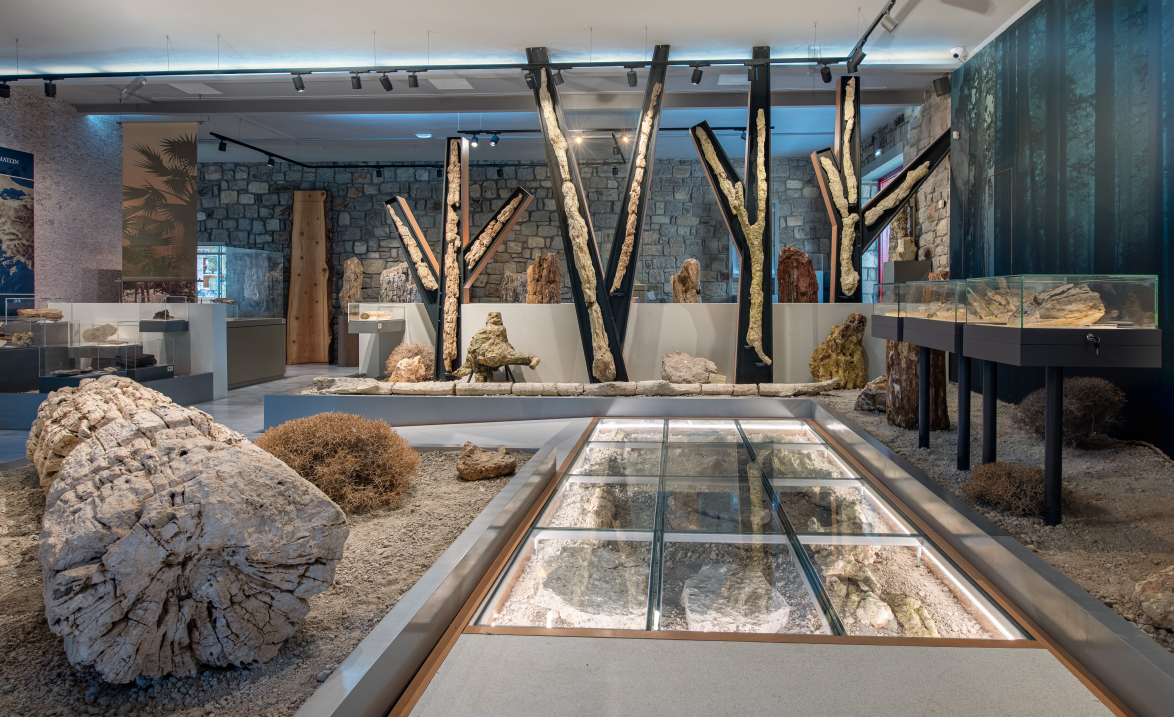
To further protect and study the site, the Natural History Museum of the Petrified Forest of Lesvos was founded in 1994 in the village of Sigri. The museum and the surrounding protected areas serve to preserve these invaluable fossils and educate the public about the geological history of the region.
Today, the Petrified Forest of Lesvos is one of the largest and most well-preserved petrified forests in the world, with its significance recognized globally as a UNESCO Global Geopark.
The Natural History Museum of the Petrified Forest of Lesvos, located in the village of Sigri, is a significant scientific and cultural institution. Its history is directly linked to the need to protect and promote the unique natural monument it represents.
History and Foundation
The museum was established in 1994 as a public-benefit, non-profit organization overseen by the Greek Ministry of Culture. Its creation was a crucial step in the long-term effort to protect the Petrified Forest, which was officially designated a protected natural monument of global importance.
The idea for the museum’s creation was championed by Nikos Sifounakis, who as Prefect of Lesvos in the 1980s, initiated the groundwork for its construction. The community of Sigri provided the land for the building, demonstrating local commitment to the project.
The museum’s primary mission from its inception has been:
- Protection and Conservation: To safeguard the rare petrified tree trunks and other fossils found in the area.
- Research and Study: To serve as a center for geological and paleontological research, collaborating with universities and international organizations.
- Education and Awareness: To inform the public about the geological history of Lesvos and the formation of the Petrified Forest, which was created by volcanic activity about 20 million years ago.
The museum’s establishment was a pivotal moment for the region, transforming the Petrified Forest from an archaeological site into a modern, organized geological park and research center. It is now a founding member of the European Geoparks Network and a member of UNESCO’s Global Geoparks Network, underscoring its international significance.